The Diagrams Book: Diagrams Are Not for AI to Read, But for Humans
The book I want to recommend is The Diagrams Book, Kevin Duncan’s 100 ways to solve every problem by seeing it as a diagram, in the Thai edition from How to publishing, at 272 pages.
In an era where AI can genuinely take over human tasks, many might assume that diagrams, charts and other visual frameworks are becoming obsolete. I think the opposite is true. AI doesn’t need diagrams at all, because it understands the world through mathematical vector calculations. It’s humans who still need them.
If we truly want to be Human in the loop, Human on the loop, or Human over the loop (not just a role title that sounds good on a slide), we must find the point where the human brain can “handle it,” and the diagram is that point of connection. It is also a skill and a method for passing on knowledge from one generation of humans to the next, one that nothing can yet replace.
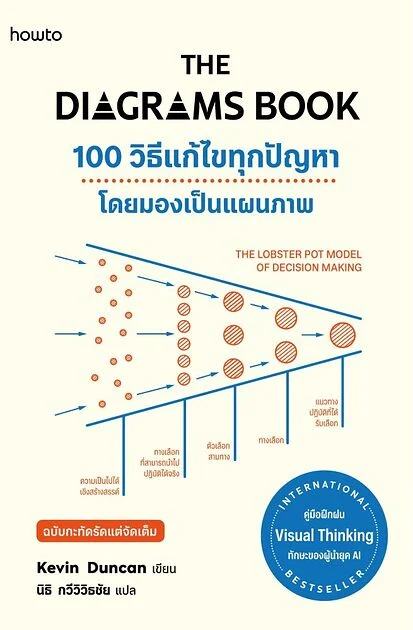
A diagram is not art, but a “weapon of thought”
Many people might assume that diagrams are merely decorative elements in a presentation, designed to look appealing and be easy to remember. The author, a seasoned business consultant and marketer, completely overturns that perspective. This book demonstrates that a diagram is a process for organizing thoughts, a tool that transforms complexity into simplicity, applicable to everything from work and business to relationships and personal organization.
It doesn’t just teach drawing; it compiles tools for real-world use
What earned it the most extra points from me is that this book is not merely about how to draw diagrams or charts; it is a dense compilation of the body of knowledge behind diagrams actually used in the business world, including the BCG Matrix and the Growth Strategy Matrix, which are tools that consultants and executives have genuinely relied on for decades.
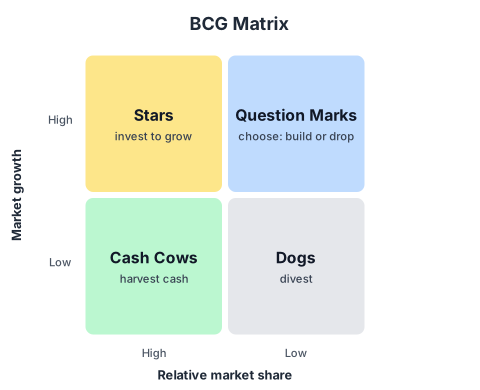
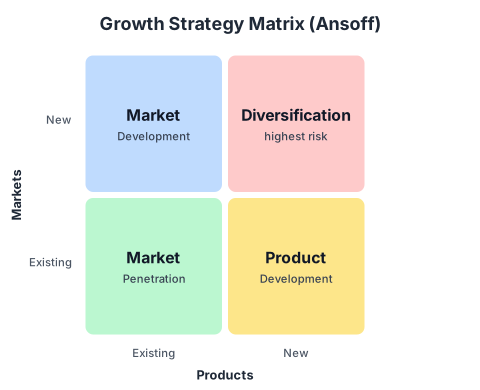
Gathering 100 diagrams in a single volume saves a great deal of research time, as we no longer have to hunt for each tool one by one across multiple sources.
Categorize by “shape,” not by problem
The author does not categorize by problem type (e.g., finance, relationships) but by the geometry and shape of the diagrams, which allows for a deeper understanding of the core of each tool. It starts with Triangles & Pyramids, for setting priorities, organisational structure or the levels of a problem: what is the foundation, and what is the ultimate goal. Next come Squares & Axes, matrices for comparing, finding a balance and making hard decisions. Circles & Pies show proportions, cycles and where things overlap. Timelines & Yearly Overviews help with planning, managing deadlines and keeping the big picture in focus. And Flows & Concepts explain complex processes or steps, from upstream to downstream.
Each diagram is brief, concise, and to the point. So we flip through to find the one that matches the situation at hand, then just start drawing along.
Who It’s For
This book is especially well suited to office workers, particularly those who do not yet have much experience, because they can learn the principles, research further and gather it all into an arsenal that puts them on a par with experienced people. It also works as a refresher for those who already have the experience. It suits marketers and strategists too, who analyse competitors, look for business opportunities and manage customer relationships, and general readers who feel overwhelmed and short of focus, because slowly drawing out their own thinking as a diagram helps bring their attention back to the matter at hand.
How the AI Pros Use It
People who want to build working systems through Vibe Coding, letting AI write the code and much else for them, still need to understand the output they want, how to measure the result, how to track the work and how to present it. So someone who has only the AI skill of prompting, without this kind of accumulated knowledge, cannot compete with someone whose knowledge is clear, because they will not have sharpened their thinking, and they will never be as precise as someone who can communicate straight to the target.
Things to Know Before Using It
This book may not be suitable for simply grabbing a diagram and using it immediately without further study on how each one should be applied (with as many as 100 types, some diagrams are explained broadly and do not delve into specialized theory). However, it makes everything much easier and requires little time for further study, as the book provides an appropriate level of detail.
And this is not a book that will make you an expert the moment you finish reading it. You need paper, a pen, and you must actively draw and think along with it to get the full benefit from it.
Pick It Up, Draw It, Then Start Thinking
The Diagrams Book is not an ordinary how-to book, but a “Cognitive Toolbox” that can be drawn upon throughout one’s life. And the more AI takes over tasks we once did, the more indispensable the ability to distill complex matters into images that humans can collectively understand becomes.
I give it 9 out of 10 for readability and 9.5 out of 10 for practical use… but it will do nothing for us if we don’t “pick it up” and draw, and “try” it on our own real problems starting today.
Where to Buy
The Diagrams Book (Thai edition) is available from the Naiin bookstore website.

