The Three Happiness Pyramid: My Most Recommended Book
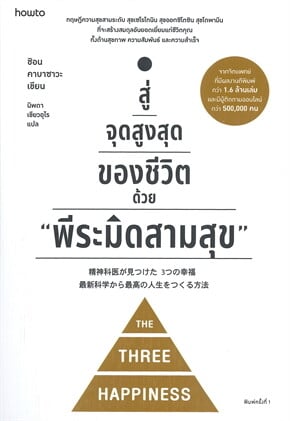
The book I would like to recommend is Reaching the Peak of Life with “The Three Happiness Pyramid” by Shion Kabasawa, in the Thai edition published by How to, 342 pages long.
Over the past three to four years, if anyone has asked me directly which book I recommend the most, the answer has truly been this one.
I have been reading this author’s books all along. He is someone who writes in a fascinating way, with content that is highly practical and reasoning that is complete and excellent. But this book is on another level entirely, because it uses brain science to explain real-world application for real, not just beautiful aphorisms that feel good for a single day.
Happiness is not a floating emotion but a chemical in the brain
In an era saturated with stimuli and materialism, we often chase happiness by trying to earn as much money as possible and achieve success as quickly as possible. Yet why do so many people who appear to have it all feel “empty” and joyless? The author, a psychiatrist and a scholar in Neuroscience, answers this question through the mechanisms of brain chemicals, rather than through philosophy.
The core of the book is that happiness is not an intangible emotion, but a scientifically explainable reaction, divided into three overlapping levels forming a “Three Happiness Pyramid.” The foundation is serotonin-based happiness, which is happiness related to health: a strong body and a peaceful mind. The middle layer is oxytocin-based happiness, which is happiness related to relationships: love, family, friends, and the ability to connect with others. The apex of the pyramid is dopamine-based happiness, which is happiness related to achievement: money, career, honor, and the attainment of goals.
The fundamental rule is to build from the base up to the peak; you must not skip levels or go against the flow. If we chase only dopamine (money and success) while neglecting serotonin (health) and oxytocin (the people around us), the pyramid of life will eventually collapse. It sounds like something everyone already knows, but once it is explained through the mechanisms of the brain, we stop arguing with it immediately.
A How-To Backed by Science
The book’s structure is highly systematic. It begins by laying the groundwork that happiness is a chemical in the brain, clearly capturing the three types of happiness and understanding its four properties. It then moves entirely into practice: seven ways to access serotonin-based happiness, seven ways for oxytocin, and seven ways for dopamine. It concludes with daily habits—regarding money, leisure, and food—that will transform life into one of sustainable happiness.
The techniques in this book can be practiced from the moment we wake up until we fall asleep, and what I love about them is that they help us re-prioritize our lives, keeping us from falling into the trap of “fake happiness”—the kind that can never be filled no matter how much we pour in, and that slowly drains our life force without us even realizing it.
Knowledge So Powerful It’s Terrifying
The first time I read this book, I felt that it was useful not only to executives or those interested in happiness and love, but even to crooks. If they could grasp the essence of the subject matter related to happiness to this level, that would be quite frightening.
I am not joking. The knowledge that explains what makes humans feel good, feel connected, and desire to have things is knowledge that can be used for both creation and destruction. The more precisely a book explains it, the more powerful it becomes (and the more it should be in the hands of those who intend to use it to create value for others).
It Works in Practice, and Fits My Customer Centric Approach Intensely
Understanding the three forms of happiness enhances our capacity in many aspects of actual work. This applies at the individual level, such as self-care and team management, all the way to planning how we present products and services—specifically, identifying which level of happiness our offerings address for the customer: health, relationships, or success.
All of this content is intensely connected to my Customer Centric approach, because putting the customer at the center without truly understanding what makes them happy is nothing more than a slogan plastered on the wall.
I was so enthusiastic that I nearly cheered out loud, urging all my subordinates to read this book (so I wouldn’t have to work so hard).
Who It’s For
This book is for those who are so workaholic that they lose their balance, who chase money or obsess over success to the point of ruining their health or straining their families. It is for those who feel adrift and unfulfilled, even when their lives appear to have no problems, yet they never feel truly satisfied. It is also for those who prefer principled self-improvement, who want a how-to book that explains cause and effect in a systematic, evidence-based way. Moreover, executives, managers, and those working in marketing or product and service design will benefit from this book more than they might expect, because the ultimate goal of all our work is to make others happy in the right way.
Things to Know Before Using It
For those familiar with mental health or Positive Psychology books, the topics of taking care of one’s health and prioritizing relationships may feel like old news. But arranging them into a three-tier pyramid model makes the picture far clearer and much easier to remember and apply (knowing something and doing it in the right order are two very different things).
Build from the base, then climb to the top
The Three Happiness pyramid serves as a compass guiding life through a chaotic world. It helps untangle the misconceptions about happiness that many have carried throughout their lives, and teaches us to draw the right connections to happiness, so that we can unlock our full potential without breaking ourselves in the process.
What I feel makes this book absolutely worth it is that it compiles content that is hard to find in other books, and explains it intensively, on point, and in a way that is actually actionable. Is the book that perfect? I would give it ten out of ten on every point, but there is just one small catch: it might offer a few too few examples, which is also a good thing because it keeps the book from getting too thick. 555
I rate the readability 9.5 out of 10 and the practical applicability 10 out of 10… And if you’re asking where to start, you must start from the foundation today: “care for” your health, “look after” the people around you, and then gradually “climb” your way up to success.
Where to Buy
Order Reaching the Peak of Life with “The Three Happiness Pyramid” (Thai edition) from the Naiin bookstore website

